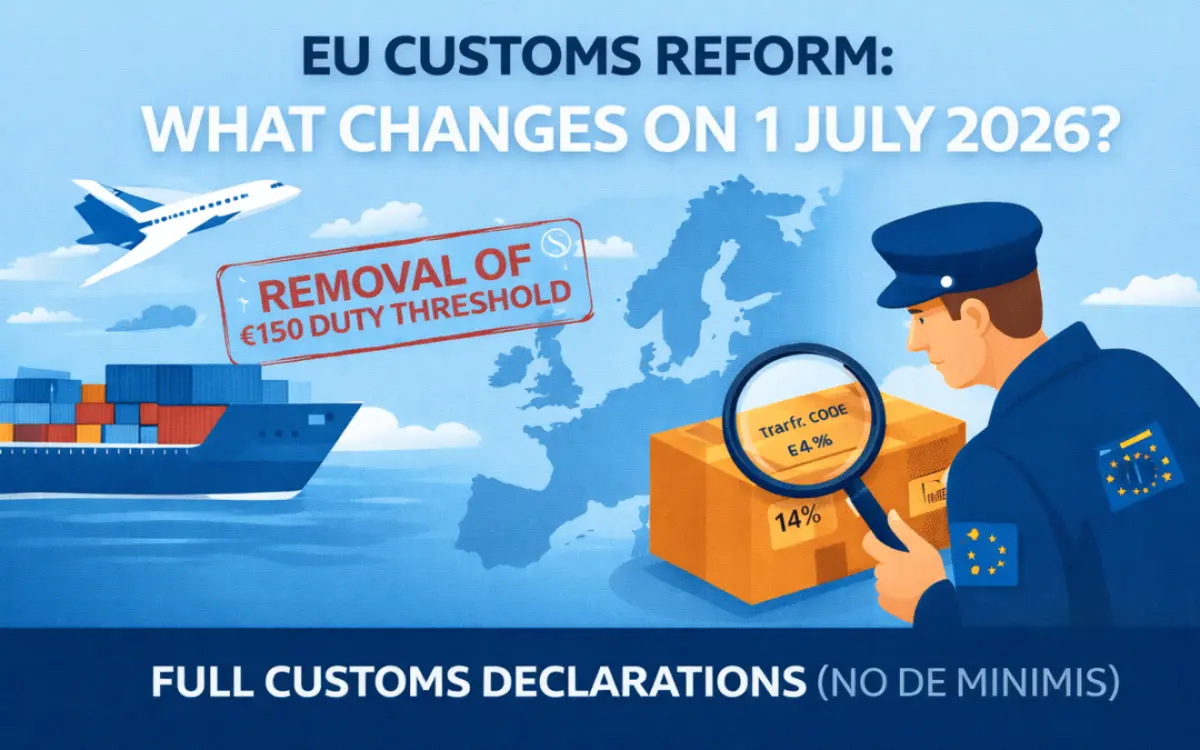
From 1 July 2026, the EU will remove the €150 customs duty de minimis threshold for imports into the European Union.
This is a customs reform — not a VAT reform — but it will still affect businesses using IOSS.
Let’s break this down properly.
What is Changing on 1st July 2026?
Currently:
-
Goods valued at €150 or below are exempt from customs duty.
-
These goods can use the H7 simplified declaration.
-
Many low-value eCommerce imports rely on this structure.
From 1 July 2026:
-
The €150 customs duty exemption will be removed.
-
Customs duty may apply regardless of value (depending on tariff classification).
-
Full customs declarations will become more common.
-
The simplified low-value import environment will narrow.
This is an EU-wide structural customs change.
Effect on Import One Stop Shop (IOSS)
There is a common misunderstanding between the customs code and the vat directive when we discuss IOSS shipments.
IOSS was introduced to:
-
Simplify VAT reporting for B2C imports under €150.
-
Allow VAT to be collected at checkout.
-
Avoid import VAT collection at the border.
IOSS does not remove customs duty.
The reason duty was often not charged is because:
-
There was a separate €150 customs duty exemption.
-
Most low-value goods fell under that threshold.
That exemption is what disappears in July.
1️⃣ VAT Treatment Under IOSS
No change.
-
VAT must still be collected at checkout.
-
IOSS returns continue monthly.
-
Import VAT exemption still applies when IOSS is valid.
The VAT framework remains intact.
2️⃣ Customs Duty Exposure
From 1 July:
-
Goods under €150 may still require customs duty.
-
Duty rates will depend on the tariff code.
-
IOSS does not remove that duty.
This means:
-
Sellers using IOSS may still have duty liability.
-
Pricing models may need adjusting.
-
Margin assumptions based on “low-value = no duty” will no longer hold.
3️⃣ Declaration Complexity
We expect:
-
Reduced reliance on H7 simplified declarations.
-
Increased use of full customs declarations.
-
More tariff code scrutiny.
-
Greater data requirements.
Even if IOSS remains valid for VAT, customs processes will become heavier.
Before 1st July 2026
- €120 shipment
- IOSS used
- No customs duty (due to €150 exemption)
- VAT paid at checkout
- Simplified customs clearance
After 1st July 2026
- €120 shipment
- IOSS used (VAT still collected at checkout)
- Customs duty may apply depending on tariff classification
- More detailed customs declaration required
Action Plan for eCommerce Sellers
Businesses should now:
-
Review tariff classifications.
-
Model duty exposure below €150.
-
Recalculate margin on low-value goods.
-
Assess whether DDP structures need adjustment.
-
Prepare for increased clearance documentation.