What U.S. Ecommerce Sellers Need to Sell into Europe (2025 Complete Guide)
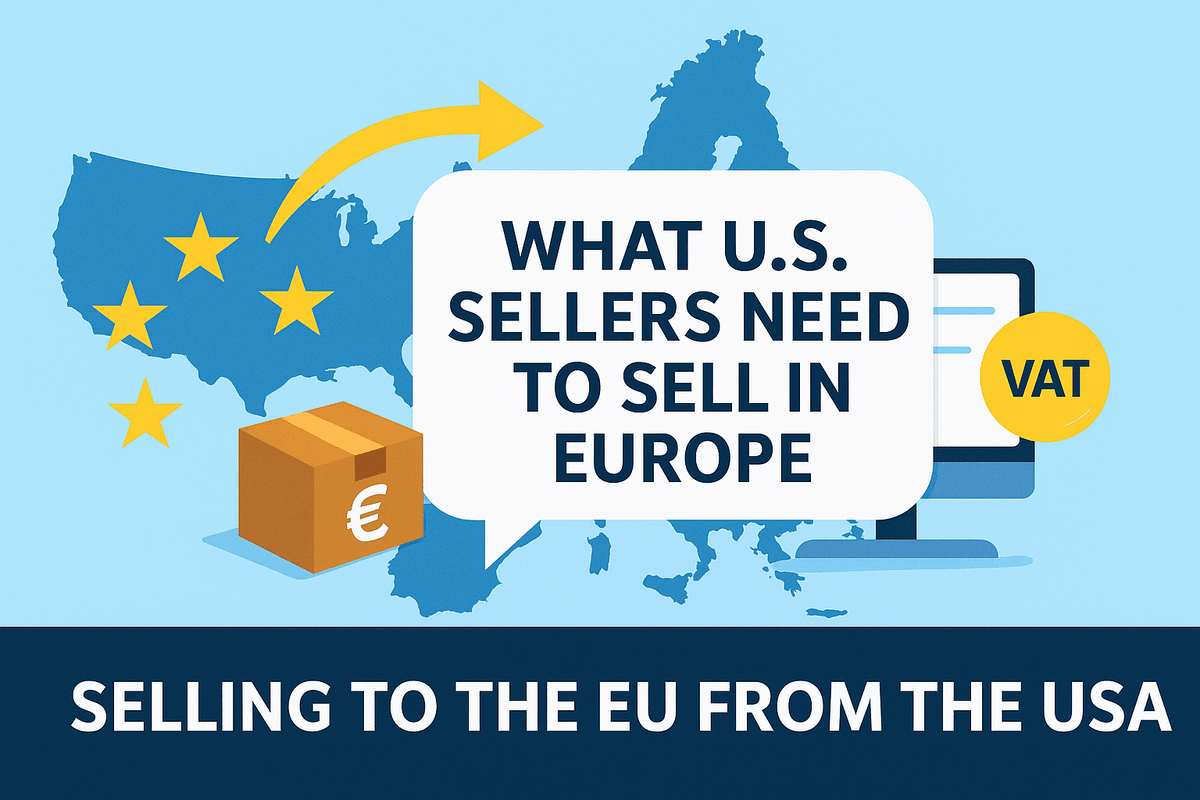
This guide explains how U.S. ecommerce companies—including Amazon FBA, Shopify, WooCommerce, and DTC brands—can legally sell to customers in the EU and UK. We cover importing, EORI, VAT registration, OSS/IOSS, EPR (Extended Producer Responsibility), fiscal representation, Amazon PAN-EU, and VAT refunds, with a practical launch roadmap.
1) Importing into the EU & UK: EORI, Customs, and First-Country Strategy
Before listing products or shipping inventory, non-EU businesses must be recognized by customs. That begins with the EORI (Economic Operator Registration and Identification) number and a clear plan for your first import country (often Germany, Netherlands, or France). Many U.S. sellers start by importing to one country, then expand across the region.
- EORI (EU/UK): Required to interact with customs. If you import into both the EU and UK, you’ll typically need both an EU EORI and a UK EORI.
- Importer of Record (IOR): You (or an appointed IOR) are responsible for customs declarations, import VAT, and product compliance.
- Product compliance: CE/UKCA (where applicable), language labelling, safety standards (e.g., toys, electronics), and restricted items.
- Inventory placement: Decide whether to hold stock in one country first, then switch on PAN-EU later for faster Prime-like delivery.
Get started 👉 Apply for your EORI & VAT with VAT Digital
2) VAT Registration & Obligations for Non-EU Sellers
Once you import or store inventory in the EU/UK, you’ll generally need a local VAT registration. U.S. sellers trigger VAT obligations when they:
- Store goods in an EU Member State (e.g., FBA inventory in Germany or Poland).
- Import goods into the EU/UK and sell locally.
- Use multi-country fulfillment (e.g., PAN-EU) where stock moves across borders.
What VAT compliance involves:
- VAT number in each country where you store goods or have a taxable presence.
- Periodic VAT returns (monthly/quarterly), EC Sales/Intrastat (where relevant), and correct VAT invoicing.
- OSS/IOSS schemes to simplify certain cross-border B2C sales (see below).
👉 EU VAT Registration & Managed Filings — VAT Digital
How OSS and IOSS fit in
- OSS (One-Stop Shop): Simplifies VAT for intra-EU B2C distance sales when you hold stock in one EU country and ship to customers in others.
- IOSS (Import One-Stop Shop): For imports of consignments ≤ €150 shipped to EU customers. Collect VAT at checkout and avoid customers being charged on delivery. See our full guide: IOSS — The Complete Guide.
3) EPR (Extended Producer Responsibility): Packaging, WEEE, Batteries
EPR imposes environmental obligations on producers and sellers of packaged goods, electronics (WEEE), and batteries. Marketplaces, especially Amazon, actively enforce EPR: missing EPR registrations can lead to blocked listings or suspensions.
- France & Germany: Typically require EPR registration numbers before/at launch for packaging; WEEE/batteries apply by product category.
- Reporting & take-back/eco-fees: You’ll report packaging volumes (by material) and pay eco-contributions to compliance schemes.
- Invoices/listings: In some countries you must display EPR identifiers or include them on invoices.
4) Fiscal Representation: When U.S. Businesses Need a Local Rep
Several EU countries require non-EU businesses (including U.S. entities) to appoint a Fiscal Representative to register and file VAT. The representative is usually jointly and severally liable for your VAT, which is why some countries insist on one and may require a financial guarantee.
Fiscal Representation Requirements — Key Markets (as of Nov 2025)
| Country | Fiscal Rep Required for Non-EU Businesses? | Notes |
|---|---|---|
| France | Required | Non-EU sellers commonly appoint a rep; rules tightening around import simplifications. From 2026, changes to “Regime 42” mean direct French VAT registration and appropriate representation are expected for many non-EU workflows. Assess case-by-case. |
| Italy | Required | Fiscal rep mandatory for non-EU. Recent rules require a financial guarantee (e.g., €50k for VIES) in many cases. |
| Spain | Required | Non-EU businesses generally must appoint a fiscal rep for VAT registrations and filings. |
| Poland | Required | Non-EU sellers often need a rep unless specific cooperation conditions apply. Confirm based on your profile. |
| Belgium | Required | Rep and guarantee may be needed for non-EU registrations; depends on activity. |
| Germany | Not required | Direct registration permitted; a local agent can still be engaged for compliance support. |
| Netherlands | Not required | Direct registration allowed. Optional fiscal rep used for import schemes (e.g., Article 23 deferral). |
| Ireland | Not required | Direct registration allowed for non-EU sellers; local advisor recommended. |
| Czechia | Varies | Historically more flexible; confirm current stance for non-EU registrants. |
👉 Appoint a Fiscal Representative — VAT Digital
5) Amazon PAN-EU & Multi-Country Fulfilment (also relevant to 3PL networks)
PAN-EU lets Amazon distribute your stock across multiple EU countries for Prime-speed delivery. That convenience triggers multi-country VAT obligations because inventory will be stored and moved between Member States.
- Start with one country (e.g., Germany or Netherlands) to gain momentum and validate demand.
- When enabling PAN-EU (or a multi-node 3PL), anticipate additional VAT registrations in every country where stock is stored.
- Use OSS for B2C cross-border sales where applicable, and standard VAT returns where stock is held.
👉 Amazon PAN-EU VAT Registration — Explained
6) Common Pitfalls for U.S. Sellers — and How to Avoid Them
- Late VAT registration: Leads to blocked listings, withheld funds, or penalties. Register before shipping stock.
- No EPR when required: Amazon enforcement can remove listings. Register packaging (and WEEE/batteries where applicable) at launch.
- Expanding storage without VAT: If inventory moves to France/Italy/Spain/Poland, ensure VAT + fiscal rep (if needed) are in place first.
- Missing import VAT recovery: You can often reclaim import VAT once registered. Don’t leave 20–27% on the table.
👉 Claim VAT Refunds — VAT Digital
7) Launch Roadmap for U.S. Ecommerce Sellers
- Scope & first country: Pick a first import/storage country (DE/NL common). Confirm product compliance.
- EORI & VAT registration: Apply ahead of shipping.
- EPR registration(s): At minimum in FR/DE for packaging; add WEEE/batteries as needed.
- Fiscal representation: Appoint where required; arrange guarantees if needed (e.g., Italy).
- Ship inventory: Align Incoterms (often DDP for customer experience). Ensure customs broker alignment.
- Ongoing compliance: File VAT & EPR returns; maintain audit trail & compliant invoicing; consider OSS/IOSS for efficiency.
- Scale: Enable PAN-EU / multi-node 3PL and add registrations country-by-country.
8) Country Highlights (Fast Facts)
- Germany: Popular first hub; direct VAT registration; robust Amazon network.
- Netherlands: Efficient ports; optional Article 23 import VAT deferral via rep; direct registration allowed.
- France: EPR packaging strict; evolving import/fiscal-rep landscape. Automatic Import VAT reverse-charge.
- Italy: Fiscal rep mandatory for non-EU; financial guarantees common; quarterly filings typical.
- Spain: Fiscal rep typically required for non-EU; 2–4 week VAT registration timeline is common.
- Poland: Attractive FBA storage; confirm fiscal rep need based on your profile.
Compliance, handled. Growth, unlocked.
VAT Digital delivers VAT, EPR, fiscal representation, OSS/IOSS, and VAT refunds — coordinated across all your EU markets.
Frequently Asked Questions
Do U.S. companies need a VAT number to sell in Europe?
Yes—if you store goods in an EU country or import and sell locally, you’ll need a local VAT registration. For cross-border B2C sales without local stock, OSS may simplify VAT reporting via one EU Member State.
What’s the difference between OSS, IOSS, and standard VAT returns?
- OSS: Simplifies VAT on intra-EU B2C distance sales when you hold stock in one EU country.
- IOSS: For imports ≤ €150 shipped to EU customers; VAT is collected at checkout.
- Standard VAT returns: Required in each country where you store inventory or otherwise have a taxable presence.
See our full primer: IOSS — The Complete Guide.
When is a Fiscal Representative required?
Several countries require non-EU businesses to appoint a local fiscal rep (e.g., Italy, typically Spain, and often France/Belgium/Hungary/Poland depending on activity). Others allow direct registration (e.g., Germany, Netherlands, Ireland). Rules evolve; we confirm the requirement during onboarding.
Can I sell into the EU without forming an EU company?
Yes. A USA LLC/C-Corp can register for VAT/EPR, obtain an EORI, and sell via Amazon FBA or 3PLs across Europe. Company formation in the EU is not required for most sellers.
How long do VAT registrations take?
Typical timelines are 2–10 weeks depending on the country, documentation quality, and whether a fiscal rep/guarantee is required. We advise applying ahead of first shipment.
Can I reclaim import VAT?
In many cases, yes—once registered, import VAT can be reclaimed via VAT returns (or refund procedures). Good customs documentation and compliant invoices are essential.
Why U.S. Sellers Choose VAT Digital
- End-to-end: VAT registrations and filings, EPR setup and reporting, fiscal representation, OSS/IOSS, and refunds—coordinated centrally.
- Amazon & omnichannel expertise: PAN-EU, multi-node 3PL, and mixed DTC/marketplace setups.
- Single point of contact: One team to manage multi-country obligations, deadlines, and correspondence.