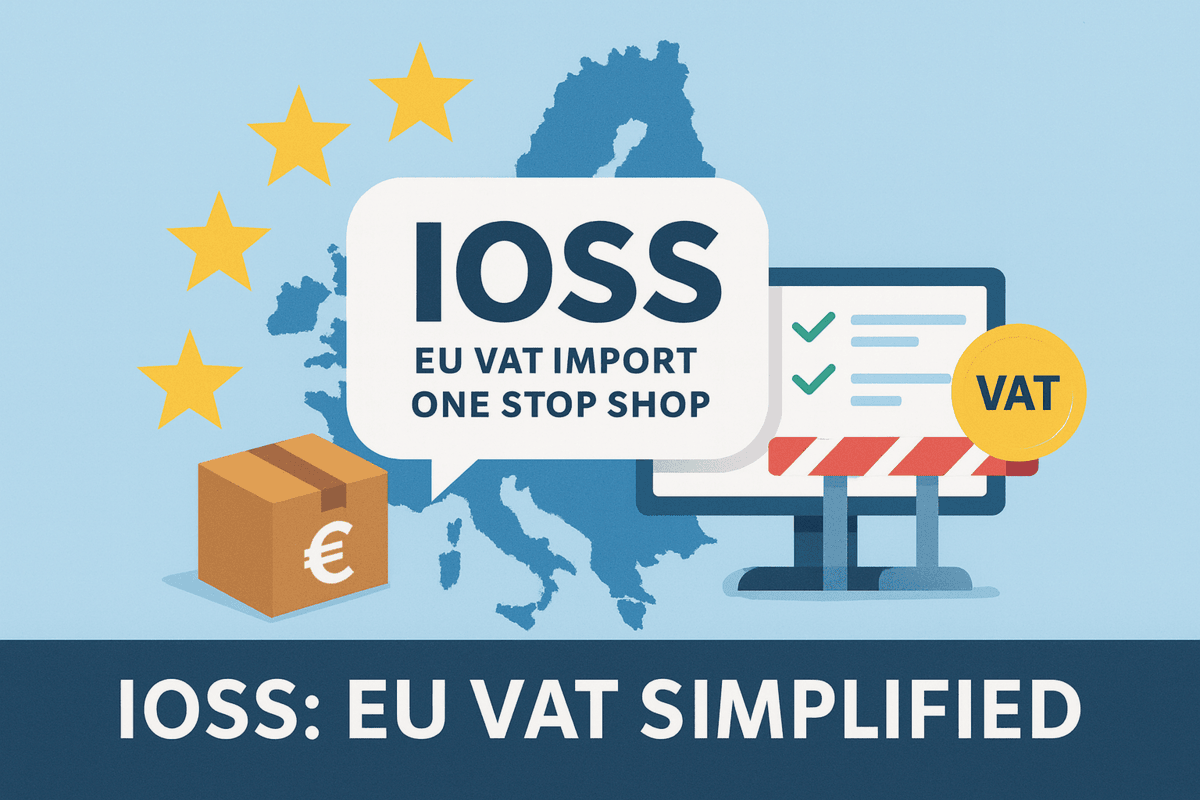
Since 1 July 2021, the EU introduced a transformative VAT regime for cross-border e-commerce: the Import One-Stop Shop (IOSS). If you sell low-value goods (valued at €150 or less) to EU customers, whether you’re based in the EU or outside, IOSS can simplify VAT obligations, reduce delivery delays, and improve customer trust. This guide covers what IOSS is, who it applies to, how to register, the benefits, and compliance steps.
What is IOSS? At a glance.
- The Import One-Stop Shop (IOSS) is a voluntary EU scheme that allows sellers to register in one EU Member State to collect, declare, and pay Value-Added Tax (VAT) on business-to-consumer (B2C) imports of goods from third countries (i.e. non-EU) where each consignment has an intrinsic value of no more than €150.
- The scheme became effective 1st July 2021, when the EU abolished the previous exemption for low-value imports under €22.
- Under IOSS, VAT is collected at the point of sale, so customs does not collect VAT upon import if IOSS is used. This reduces surprise fees for the consumer and speeds up customs processing.
- The non-EU business must appoint an EU intermediary to register for the scheme but EU companies can register directly in their own country.
- Goods subject to excise duties are excluded (alcohol,tobacco etc
- IOSS filings and payment are completed monthly
Who can register for IOSS?
Elligible Users
- EU-established sellers shipping low-value goods from outside the EU to EU consumers.
- Non-EU sellers—must appoint an EU intermediary (fiscal representative) to use the import scheme.
- Marketplaces/electronic interfaces may be treated as deemed suppliers and can operate IOSS for marketplace sales.
Applicable Goods Limits
- Value: Intrinsic value ≤ €150 per consignment.
- Goods: B2C only; excise goods (alcohol, tobacco, etc.) are excluded.
- Origin/flow: Goods must be outside the EU at sale and shipped direct to the EU consumer.
If you don’t use IOSS
Import VAT is collected on arrival; couriers may add expensive handling fees, which can cause delivery delays and customer complaints—a key reason many sellers adopt IOSS in the first place.
How IOSS actually works (step-by-step)
1. Registration
- You register IOSS in a single EU member state, regardless of where the consumer is based.
- EU sellers must register with the member state they are incorprated in.
- Non-EU sellers MUST appoint an EU intermediary to register for the import scheme. Their country of identification will be where the intermediary is incorporated.
- The same rules apply for marketplaces who are deemed sellers.
2. Selling & Implementation
Once you have received your unique IOSS ID (Import One-Stop Shop identification number) you can start to sell goods with the scheme.
- Your checkout on your website needs to be configured to charge the applicable destination VAT rates to the consumer at point-of-sale.
- All shipments must be below ≤ €150 to clear customs smoothly.
- The invoice must clearly show the breakdown of VAT charged
3. Shipping & Customs
You can choose to ship your own goods or appoint freight forward/ fast parcel carrier to deliver and make customs declarations on your behalf.
- You must Include your IOSS VAT ID in the electronic customs data used for EU risk assessment/clearance (e.g., via Import Control System ICS2)
- With a valid IOSS ID and value ≤ €150, no VAT is charged at the border (it was prepaid at checkout)
4. Filing & Payment
A single IOSS VAT return is submitted once per month (even nil) and paid to your member state of identification.
The member state then redistributes this EU-wide to all of the tax jurisdictions you have made taxable sales in.
Does my business qualify?
Use this checklist to see if you qualify and can use the special scheme
- Are all consignments ≤ €150 (excluding duties; check how you treat shipping/insurance in pricing)?
- Are they B2C orders? (If you mainly sell B2B, IOSS is not applicable.)
- Are you shipping from outside the EU directly to EU consumers?
- If you’re non-EU, do you have an EU intermediary ready?
- Do you understand marketplace rules (the marketplace may handle IOSS for those transactions)?
Things to consider
1. Marketplace vs own-site
If you sell exclusively via a marketplace that acts as a deemed supplier, you may not need your own IOSS for those orders. But for your own-website checkout, you do. Many merchants run both flows; keep the IDs/processes separate in your OMS/WMS as you will need to input the correct ID on the package and declaration.
2. ICS2 data quality control
Border pre-clearance relies on accurate electronic data (description, value, IOSS ID, buyer details). Poor data leads to holds and manual intervention; align with your carrier and ensure your systems populate the IOSS ID correctly.
3. Record-keeping
Returns require destination country breakdowns and VAT collected per Member State. Keep audit-ready logs of sales, returns, and adjustments per month. These records must be kept for 10 years from the end of the year the supply was made.
4. UK sellers post-Brexit
The UK is non-EU for VAT purposes. UK sellers shipping to the EU can use IOSS but must appoint an EU intermediary to facilitate filing & payment.
IOSS vs OSS vs Special Arrangements
| Scheme | What it covers | Who uses it | Key trigger |
|---|---|---|---|
| IOSS | Imports of B2C low-value goods (≤ €150) from non-EU → EU | EU & non-EU sellers, marketplaces | VAT at checkout; monthly IOSS return |
| OSS (Union / Non-Union) | Intra-EU distance sales & some services | EU sellers (and some non-EU for services) | Centralised filing within the EU |
| Special Arrangements | Alternative collection for ≤ €150 consignments when IOSS is not used | Postal/courier collects VAT from buyer at import | VAT due on arrival; handling fees likely |
Returns, refunds & adjustments
1. All IOSS returns are submitted monthly by the end of the following month.
2. Returns/refunds: These are adjusted in the subsequen IOSS return for the member state where the original transaction was recorded and paid. Keep documentation to link the original sale and refund.
3. Nil Returns are still required when no sales take place in the reporting period.
Striking Off and Member State Responsibilities
⚠️ Important: The Striking Off System
When you register for IOSS, your Member State of Identification (MSI) manages all VAT returns and payments. If you miss a filing or payment deadline, the MSI will automatically send a reminder on the 10th day after the due date and alert the Member States of Consumption (MSC).
If you still don’t comply, the MSC takes over responsibility: they issue further reminders and can pursue collection of VAT directly under their national procedures. If this happens for three consecutive return periods, and the debt is not cleared within 10 days of each reminder, you are considered persistently non-compliant.
The result: the MSI can strike off your business from IOSS. Once struck off, you cannot re-register for two years. Small amounts (less than €100 VAT per period) may not trigger exclusion. From then on, every Member State of Consumption can chase the VAT directly, fragmenting what was previously a single EU-wide process.
In short: Miss a deadline → 10-day MSI reminder → MSC pursue the debt → 3 strikes → Struck off → 2-year lockout → Each EU country chases you individually.
Common Questions from Clients
The Import One-Stop Shop applies to consignments with an intrinsic value ≤ €150 at the time of supply. Goods above this amount are outside IOSS scope; excise goods are also excluded.
Transport, insurance and handling may be excluded from the intrinsic value only if they are clearly itemised separately on the invoice. If bundled or not itemised, they can count toward the threshold.
The low-value VAT exemption up to €22 ended on 1 July 2021. From that date, all imports are subject to VAT and IOSS / special arrangements apply for consignments ≤ €150.
No — IOSS is optional. Without IOSS, import VAT (and often handling fees) is typically collected at the border for eligible consignments.
EU-established sellers can register directly. Non-EU sellers generally must appoint an EU-established intermediary to use the import scheme.
The consignment is not eligible for IOSS. VAT (and possibly customs duties) are handled under standard import rules at the border.
It’s the price of the goods themselves at the time of supply. Charges like transport or insurance can be excluded if clearly itemised separately.
Sellers charge destination VAT at checkout and file a monthly IOSS return to their Member State of Identification (or via an intermediary). That state redistributes VAT to the relevant Member States of Consumption.
Excise goods (e.g., alcohol, tobacco) are excluded, and consignments with intrinsic value over €150 are outside scope.
The MSI issues a reminder on the 10th day after the deadline and informs the Member States of Consumption. If non-compliance continues, the MSC may issue further reminders and collect VAT directly. Persistent non-compliance (e.g., three consecutive periods not settled within 10 days of reminders) can lead to exclusion (striking off) and a two-year lockout.