IOSS €150 Threshold to Be Removed: What the 2028 IOSS Changes Mean for Sellers
Key takeaways
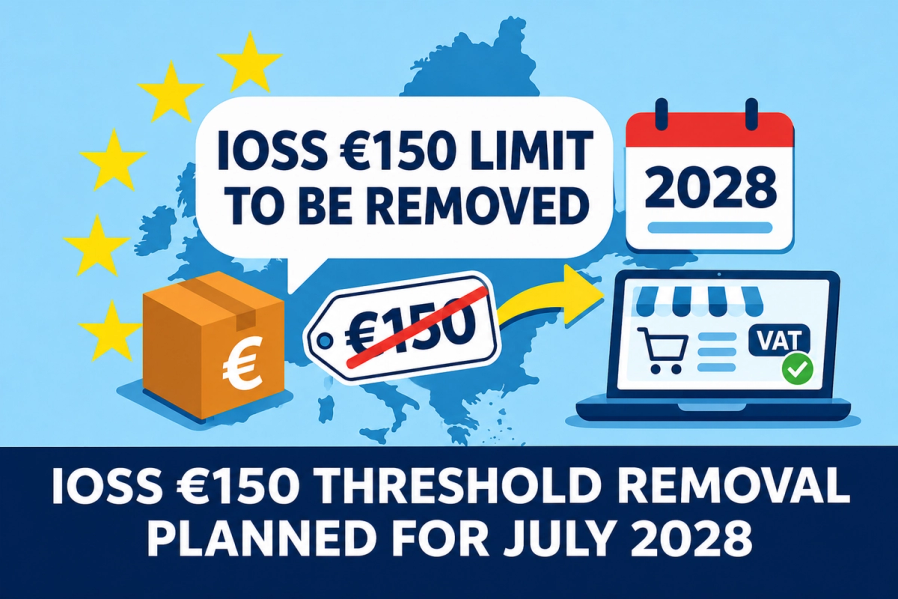
- On 9 November 2026, EU Member States reached a general approach in the Council to remove the €150 threshold for the Import One-Stop Shop (IOSS).
- From 1 July 2028, once the EU Customs Data Hub is operational, IOSS and the marketplace deemed supplier rules will cover imported goods of any value. Excise goods stay excluded.
- Nothing changes yet for VAT: until then, IOSS can only be used for consignments with an intrinsic value of €150 or less.
- The customs side has already changed: the €150 duty exemption ended on 1 July 2026, with a temporary €3 duty per item and a €2 Union handling fee from 1 November 2026.
- Sellers shipping to EU consumers should put their IOSS registration and intermediary in place now, so the 2028 changes are a settings change, not a new project.
What the EU Has Agreed on the IOSS €150 Threshold
On 9 November 2026, EU Member States reached a general approach in the Council on removing the €150 threshold for the VAT Import One-Stop Shop (IOSS). The European Commission welcomed the agreement the same day in its official announcement (opens in a new tab). Once the new Directive is adopted, online sellers and marketplaces will be able to declare and pay the VAT on all goods sold online from outside the EU through a single IOSS registration, whatever the value of the consignment.
This is the last step in removing the €150 de minimis for EU e-commerce. The 2021 VAT e-commerce package made VAT due on every imported item, however small. The EU customs reform then removed the €150 exemption from customs duty. The IOSS limit is the last part of the €150 rule still standing, and it is now set to go.
Online sellers and marketplaces will be able to declare and pay VAT on all goods sold online from outside the EU through a single registration, regardless of their value.
€21 billion+
VAT collected through IOSS since July 2021
The scheme works, which is why the EU now wants it used for imported goods of every value, not only parcels up to €150.
Source: European Commission, 9 November 2026 (opens in a new tab)
Important
Nothing changes yet
The agreement is not yet law, and the new rules are planned to apply from 1 July 2028. Until then, IOSS can only be used for consignments with an intrinsic value of €150 or less, and higher-value parcels still pay import VAT at the border.
What Is IOSS and How Does the €150 Threshold Work Today?
The Import One-Stop Shop (IOSS) is the EU scheme that lets a business selling imported goods to EU consumers charge VAT at checkout and declare it in one monthly IOSS VAT return, filed in a single Member State. The seller's IOSS number goes on the customs declaration, so the parcel clears without import VAT being collected at the border and the customer pays no surprise charges on delivery. For a full introduction, read our complete guide to the Import One-Stop Shop.
Today, IOSS only covers distance sales of goods imported in consignments with an intrinsic value of €150 or less. Intrinsic value is the price of the goods themselves: transport and insurance are left out when they are shown separately on the invoice, and so are other identifiable taxes and charges. Goods subject to excise duty, such as alcohol and tobacco, cannot use IOSS at all.
What Happens Above €150 Today
A consignment worth more than €150 cannot go through IOSS. Import VAT and customs duty are paid at import instead: either by the seller as importer of record on a delivered duty paid (DDP) basis, which usually means an EU VAT registration in the country of import, or by the customer on delivery, often with a carrier's handling charge on top. Unexpected charges at the door are one of the most common reasons for refused deliveries and returns in cross-border e-commerce.
| Topic | Until 30 June 2028 | From 1 July 2028 (planned) |
|---|---|---|
| IOSS consignment limit | Intrinsic value up to €150 | No limit: goods of any value |
| Marketplace deemed supplier rule for imports | Consignments up to €150 | All distance sales of imported goods the platform facilitates |
| Consignments above €150 | Import VAT paid at the border by the importer or the customer | VAT charged at checkout and declared through IOSS |
| Goods sold from EU customs warehouses | Not covered by IOSS | Covered when sold from the new customs warehouses for distance sales |
| Excise goods (alcohol, tobacco) | Excluded | Still excluded |
| Customs duty on low-value parcels | Temporary €3 duty per item (since 1 July 2026) and €2 Union handling fee (since 1 November 2026) | Normal customs duties once the EU Customs Data Hub is fully operational |
What Changes From 1 July 2028
The Council's text makes four changes to the IOSS scheme.
1. IOSS for Imported Goods of Any Value
The €150 ceiling disappears. IOSS will apply to all distance sales of imported goods, so a seller can charge VAT at checkout on a €40 phone case and a €900 laptop alike, and report both in the same IOSS return. Products subject to excise duty remain excluded.
2. Marketplaces Become the Deemed Supplier on All Imported Sales
Under today's deemed supplier rules, an online marketplace that facilitates the sale of imported goods is treated as the seller for VAT, but only for consignments up to €150. From 2028, platforms will be responsible for the VAT on all the imported sales they facilitate, whatever the value. Read more about IOSS rules for online marketplaces and electronic interfaces.
3. IOSS Extended to Customs Warehouses for Distance Sales
The new Union Customs Code introduces customs warehouses for distance sales, where non-EU sellers can hold goods in the EU before they are sold to consumers. IOSS will also cover goods sold from these warehouses. This is a new type of warehouse: stock that has already been cleared through customs, such as ordinary fulfilment-centre stock, does not automatically qualify.
4. Stronger Safeguards for IOSS Intermediaries
Most non-EU sellers must appoint an IOSS intermediary, an EU-established business that registers for IOSS on their behalf and is jointly responsible for the returns. The Commission will harmonise the criteria for intermediaries in an implementing act, to tackle fraud and misuse of IOSS numbers (see our article on IOSS validation issues at EU customs). By December 2030, the Commission will also review how the scheme works, including how effectively it collects VAT.
Why the Date Depends on the EU Customs Data Hub
The Commission states that the new IOSS rules will only apply once the EU Customs Data Hub, with its stronger risk assessment against fraud, is operational. Under the EU customs reform (opens in a new tab), use of the Data Hub becomes mandatory for e-commerce on 1 July 2028, which is why 1 July 2028 is the planned start date. Because the two are linked, any change to the Data Hub timetable could move the IOSS date too.
Next Steps Before the IOSS Changes Become Law
From agreement to application
-
9 November 2026: Council general approach
EU Member States agreed the text of the Directive removing the €150 IOSS threshold.
-
European Parliament consulted again
At the Council's request, the Parliament gives its opinion on the revised text.
-
Formal adoption by the Council
The Council formally adopts the Directive, which Member States then build into their national VAT laws.
-
1 July 2028: new rules apply
IOSS and the deemed supplier rules cover imported goods of any value, once the EU Customs Data Hub is operational.
-
1 December 2030: Commission review
The Commission reviews how IOSS works, including how effectively it collects VAT.
IOSS, Customs Duty and the Handling Fee Are Not the Same
The IOSS threshold is a VAT rule. The customs charges on low-value parcels are separate, and they already apply:
- Customs duty: since 1 July 2026, goods under €150 are no longer exempt from customs duty. A temporary €3 customs duty per item applies to low-value consignments until normal duties take over with the Data Hub. See what changed on 1 July 2026.
- Union handling fee: a €2 fee has applied since 1 November 2026.
- VAT through IOSS: charged at checkout at the VAT rate of the customer's country, and paid through the monthly IOSS return.
Warning
IOSS pays the VAT only
Customs duty and the handling fee are still settled at customs clearance, usually through your carrier or customs representative, so build them into your prices and delivery terms.
Who Is Affected by the IOSS Changes?
- Non-EU online sellers, including UK sellers: especially those shipping goods worth more than €150, such as electronics, furniture, jewellery or premium fashion, who today rely on import VAT at the border or VAT registrations in several countries.
- Online marketplaces and platforms: which take on VAT liability for all the imported goods they facilitate, not only consignments up to €150.
- Sellers already registered for IOSS: who will be able to bring their higher-value orders into the same scheme, and should review any checkout logic that treats orders above €150 differently.
- Postal operators and couriers: who will see more IOSS numbers on higher-value declarations. See IOSS for postal operators and couriers.
- EU consumers: the change introduces no new tax. Where IOSS is used, VAT is included in the price at checkout instead of being paid on delivery.
Should You Register for IOSS Now or Wait Until 2028?
For most sellers shipping to EU consumers, waiting brings no advantage. IOSS registration already pays off on every order up to €150, and having it in place means the 2028 change is a settings update rather than a new compliance project.
Why register for IOSS now
- Charge VAT at checkout on every order up to €150, so customers pay no import VAT on delivery.
- Fewer refused deliveries and returns caused by unexpected charges at the door.
- Your IOSS number, intermediary and monthly returns are already running before July 2028.
- Extending IOSS to higher-value orders in 2028 becomes a change to your checkout settings.
What to know before you register
- If you are based outside the EU, you will usually need an EU IOSS intermediary.
- An IOSS return is due every month, including months with no sales.
- IOSS covers VAT only: customs duty and the €2 handling fee are paid separately.
- Until July 2028, orders above €150 still need another import route.
Register for IOSS with VAT Digital
How to Prepare for the 2028 IOSS Changes
Your IOSS checklist
-
Map your EU order values
Find out how many of your EU consignments are above €150 and how import VAT is handled on them today.
-
Register for IOSS and appoint an intermediary
Non-EU sellers usually need an EU intermediary to register. Your IOSS number covers sales to all 27 EU countries.
-
Set up VAT at checkout
Charge VAT at the rate of each customer's country. Until July 2028, apply IOSS only to consignments with an intrinsic value of €150 or less.
-
Share your IOSS number safely
Give it only to your carriers and the marketplaces you sell through, and send it electronically with the customs data, never printed on the parcel.
-
Budget for customs charges
Price in the €3 customs duty per item and the €2 handling fee, and agree with your carrier who pays them.
-
Review EU warehousing
If you hold or plan to hold stock in the EU, check whether a customs warehouse for distance sales would suit you from 2028.
-
Follow the adoption
Watch for the Parliament's opinion and the Council's formal adoption, and for any change to the Data Hub timetable.
How VAT Digital Can Help With IOSS Registration
We are a certified EU IOSS intermediary for more than 9,000 online sellers worldwide. Register now, and you will be ready to charge VAT at checkout on every EU order when the €150 threshold goes in 2028.
- IOSS registration, with VAT Digital as your intermediary
- Monthly IOSS VAT returns and payments
- Unlimited parcels, no percentage fees
- OSS and EU VAT registrations for stock held in the EU
Frequently Asked Questions
Has the €150 IOSS threshold been removed?
Not yet. On 9 November 2026 the Council reached a general approach, but the European Parliament must be consulted again and the Council must formally adopt the Directive. Until the new rules apply, IOSS can only be used for consignments with an intrinsic value of €150 or less.
When will the IOSS €150 threshold be removed?
The planned date is 1 July 2028. The Commission links the start to the EU Customs Data Hub being operational, so the rules apply only once the Hub is running.
Will IOSS become mandatory?
The agreement does not make IOSS compulsory for sellers: it widens what IOSS can be used for. Marketplaces, however, will be liable for the VAT on all the imported goods they facilitate as the deemed supplier, whatever the value.
Does IOSS cover customs duty or the €2 handling fee?
No. IOSS covers VAT only. The temporary €3 customs duty per item and the €2 Union handling fee are separate customs charges, settled at customs clearance.
Do I need an IOSS intermediary?
Businesses established outside the EU usually do, unless they are based in one of the few countries that have a VAT mutual-assistance agreement with the EU. The intermediary registers for IOSS on your behalf and is jointly responsible for your returns. VAT Digital acts as IOSS intermediary for sellers worldwide.
What is an IOSS number?
An IOSS number is the 12-character VAT identification number, starting with IM, that a seller or marketplace receives on registering for IOSS. It is passed to the carrier with the customs data so the parcel clears without import VAT being charged at the border.
Will EU customers pay more after 2028?
The change introduces no new tax. VAT was already due on imported goods of every value; with IOSS, it is included in the price at checkout instead of being paid on delivery.